

Australia & New Zealand HALAL EXPO 2026
27-29 November 2026
Melbourne - Australia

Grand Egyptian Museum (GEM)

IFSA Africa 2026
18 Gennaio 2026
Umrah and Ziyarah Forum 2026
3 Febbraio 2026Grand Egyptian Museum (GEM)
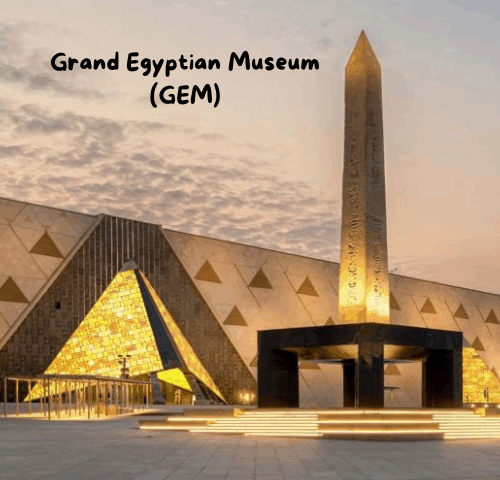
The GEM—also known as the Giza Museum or the Grand Egyptian Museum in Cairo—will house over 100,000 objects and artifacts and will cover a total area of 500,000 square meters.
The museum is located just outside Cairo, less than two kilometers from the famous Pyramids of Giza—one of the Seven Wonders of the Ancient World—and was designed to offer, among other things, a splendid window onto them.
The Grand Egyptian Museum was designed by a team of architects led by Heneghan Peng Architects (HPARC), an architectural firm based in Dublin and Berlin.
HPARC won the 2003 international competition announced the previous year by the Egyptian government. Work began in 2006 and was then awarded to BESIX, a large Franco-Belgian construction group. The project also saw the collaboration of the Irish government and financial support from the Japanese government.
The museum’s design features a modern architectural style and incorporates cutting-edge technologies to enhance the visitor experience. The building’s design was created to be harmonious with its surroundings and the nearby Pyramids of Giza.
The museum, as mentioned, will house an extraordinary collection of over 100,000 artifacts, ranging from prehistory to the Roman era.
Among these, the following are noteworthy:
The colossal statue of Ramses II, which was moved from Ramses Square in Cairo to be placed in the museum’s grand atrium.
The statue, which stands 12 meters tall and weighs 83 tons, was created 3,200 years ago.
It was discovered in 1820 by the Genoese explorer and Egyptologist Giovanni Battista Caviglia in the Great Temple of Ptah, near Memphis, the capital of Egypt during the Old Kingdom.
The statues of Ptolemy II and Arsinoe II, also located in the museum foyer.
The stone sarcophagus of Thutmose I, located at the top of the grand staircase leading to the 12 exhibition halls. Originally created for Queen Hatshepsut (his daughter), it was later remodeled and adapted to house the remains of her father, the great warrior king Thutmose I.
The entire Tutankhamun treasure, the gold collection from the famous tomb of the child pharaoh (1341 BC – 1323 BC), discovered by the English archaeologist Howard Carter in 1922.
The treasure consists of over 5,500 artifacts, now organized by Atelier Brückner and displayed together for the first time in a dedicated gallery occupying 7,000 square meters.
The obelisk.
Thousands more artifacts from the Egyptian Museum in Cairo and other Egyptian museums and archaeological sites.